
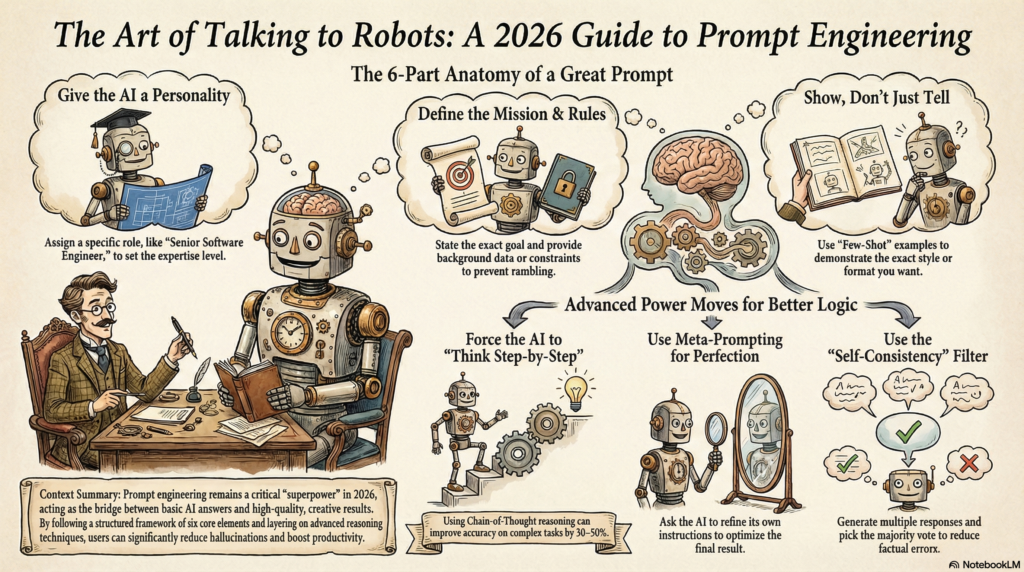
Prompt engineering is not a good skill to have in 2026. It is what sets getting basic answers from AI and getting really good, accurate and creative results from models, like Grok, Claude 3.7 GPT-4o and Gemini 2.0.
If you are a developer making agents you need to master engineering. The same goes for marketers making campaigns. Students dealing with problems and business owners automating tasks also need it. Mastering prompt engineering will make you ten times more productive. It will also greatly improve the quality of what you produce.
In this complete guide, you’ll learn:
- The exact 6 core elements every high-performance prompt needs
- 8 battle-tested advanced techniques (with real examples)
- 15+ ready-to-copy prompt templates
- Model-specific tips for the top AI tools
- Step-by-step workflow + common mistakes to avoid
Table of Contents
- What Is Prompt Engineering & Why It Still Matters in 2026
- The 6 Core Elements of Every Effective Prompt
- Advanced Prompt Engineering Techniques (with Examples)
- Step-by-Step: How to Build Powerful Prompts
- 15+ Ready-to-Use Prompt Templates
- Model-Specific Prompting Tips (Grok, Claude, GPT, Gemini)
- Best Practices, Tools & Mistakes to Avoid
- FAQ
- Final Thoughts
What Is Prompt Engineering & Why It Still Matters in 2026
Prompt engineering is about creating instructions that help big language models give you the exact output you want. This helps you get what you need faster and more accurately.
With better models coming in 2026 prompt engineering is still very important. These models can still make things up go off track or give answers if you don’t guide them right. Some techniques like Chain-of-Thought and agentic prompting are really helping to improve how these models reason and be creative.
The real benefit is that people who are good at creating prompts get 5 to 10 times results in areas, like coding making content, researching and making decisions.
Here are 7 powerful prompt engineering techniques that are changing how well big language models work:
The 6 Core Elements of Every High-Performance Prompt
Every expert prompt in 2026 follows this proven framework (endorsed across OpenAI, Anthropic, Google, and xAI documentation):
- Role/Persona — Tell the AI exactly who it is (e.g., “You are a world-class senior software engineer with 15 years at FAANG”).
- Goal/Task Statement — Clearly state the objective.
- Context/References — Provide background data, examples, or constraints.
- Format/Output Requirements — Specify exact structure (JSON, table, bullet points, length, tone).
- Examples/Demonstrations — Few-shot examples dramatically improve consistency.
- Constraints & Safeguards — Add rules like “Never hallucinate sources” or “Think step-by-step before answering.”
Master these six elements first — then layer on advanced techniques.
Best practices infographic summarizing core principles and advanced techniques.
Advanced Prompt Engineering Techniques
Here are the most effective techniques proven to work across today’s leading models:
| Technique | Description | Best For | Expected Improvement |
|---|---|---|---|
| Chain-of-Thought (CoT) | Force the model to “think step by step” | Complex reasoning, math, logic | +30–50% accuracy |
| Few-Shot Prompting | Provide 2–5 input/output examples | Consistent style or format | High consistency |
| Tree-of-Thoughts (ToT) | Explore multiple reasoning paths simultaneously | Creative problem-solving | Deeper exploration |
| Self-Consistency | Generate multiple responses and take the majority vote | Factual or logical tasks | Reduced hallucinations |
| ReAct (Reason + Act) | Alternate between reasoning and taking actions/tools | Agentic workflows | Real-world task execution |
| Meta-Prompting | Ask the AI to create or refine its own prompt | Optimizing complex tasks | Self-improving prompts |
| Role-Based + Constraints | Combine persona with strict rules and negative instructions | High-stakes or creative work | Precision & safety |
| Prompt Chaining | Break tasks into sequential smaller prompts | Long multi-step processes | Better accuracy |
Classic Chain-of-Thought example showing why “think step by step” dramatically improves results.
Example: Chain-of-Thought in action
Basic prompt: “What is the capital of France?”
Advanced CoT prompt: “You are a geography expert. Think step by step: First recall the country, then its political system, then identify the capital city. Explain your reasoning before giving the final answer.”
Step-by-Step: How to Build Advanced Prompts
- Start with the 6 core elements.
- Choose 1–2 advanced techniques.
- Write the prompt.
- Test and iterate (use “refine this prompt” meta-prompts).
- Add self-check instructions (e.g., “Before final answer, verify facts”).
- Save winning prompts as templates.
Ready-to-Use Prompt Templates (Copy & Paste)
1. General Expert Role Template
You are a [ROLE] with [YEARS] years of experience. Your style is [TONE].
Task: [EXACT GOAL]
Context: [BACKGROUND INFO]
Output format: [DETAILED FORMAT, e.g., Markdown with sections, JSON, table]
Think step by step and explain your reasoning.
2. Chain-of-Thought + Self-Consistency
Solve this problem using Chain-of-Thought reasoning. Generate 3 different reasoning paths, then select the most consistent and accurate answer.
Problem: [INSERT PROBLEM]
3. Content Creation Master Template
You are an expert [CONTENT TYPE] writer who always follows E-E-A-T principles.
Topic: [TOPIC]
Audience: [AUDIENCE]
Goal: [GOAL]
Include: real-world examples, data/stats, practical tips.
Output: SEO-optimized blog post with H2s, bullet points, and FAQ.
Model-Specific Prompting Tips (2026)
- Grok (xAI): Leverages humor and real-time knowledge. Add “Be maximally truthful and helpful” for best results.
- Claude (Anthropic): Excels at long-form, nuanced writing. Use XML-style tags for structure.
- ChatGPT / GPT models: Strong with JSON output and tool use. Specify version if needed.
- Gemini: Best for multimodal (text + image) prompts.
Best Practices, Tools & Mistakes to Avoid
Top 2026 Best Practices:
- Always iterate — never accept the first output.
- Use prompt versioning tools.
- Test across multiple models.
- Add safety layers for production use.
Recommended Tools:
- Braintrust, PromptHub, LangChain (for developers)
- Built-in prompt libraries in Claude/Grok
Common Mistakes:
- Being too vague
- Overloading one prompt
- Ignoring model limitations
- Not specifying output format
FAQ
Q1: Is prompt engineering still worth learning in 2026?
Yes — while models are smarter, advanced prompting still delivers significantly better results.
Q2: What’s the best prompt for beginners?
Start with the 6 core elements template above.
Q3: How do I create prompts for images or multimodal AI?
Use detailed scene descriptions + style references + negative prompts.
Final Thoughts & Next Steps
Prompt engineering is your superpower in the AI era. Start small: pick one technique and one template today, test it on your next task, and watch the quality skyrocket.
Bookmark this guide, save the templates, and come back whenever you need to level up.
What’s your biggest prompting challenge right now? Drop it in the comments — I’ll help refine a custom prompt for you.