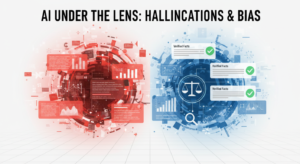
Types of Bias to Audit For
Auditing for bias in Large Language Models (LLMs) requires a multi-metric approach to identify systematic asymmetries in language choice that can lead to representational and allocational harms. Based on the sources, here are the primary types of bias to include in an audit:
- Gender Bias LLMs frequently reinforce gender defaults and perpetuate social stereotypes, such as statistically linking specific terms like “mathematician” with male pronouns or “nurse” with female ones. Auditing involves measuring demographic representation (how often different groups are mentioned) and stereotypical associations (how often groups are linked to stereotyped terms like specific occupations).
- Cultural Bias Perceptions of fairness and ethics are context-dependent and vary significantly across cultures, making a universal normative baseline difficult to achieve. Audits must investigate whether “detoxifying” a model according to Western standards inadvertently suppresses communication styles or topics acceptable in other cultural settings but flagged as toxic by standardized English-centric benchmarks.
- Political Bias Research indicates that LLMs often reflect the ideological leanings of their training data, showing consistent biases toward specific political parties or viewpoints in different jurisdictions. These can be audited by using adversarial probing, where the model is asked multiple versions of the same query to see if its responses drift inconsistently based on the political framing of the prompt.
- Confirmation Bias This human-cognitive bias can occur when developers or users perceive AI information in a way that confirms pre-existing beliefs or fills in missing information based on internal assumptions. In an auditing context, confirmation bias can prevent internal teams from recognizing critical flaws in their own models, which is why independent third-party audits are essential for maintaining objectivity.
- Geographic Bias Models often exhibit consistent performance disparities based on nationality and regional context. Auditing for geographic bias requires testing performance across regional/national varieties of English (e.g., dialects from India, Kenya, or Singapore) to ensure that the model is not optimized solely for high-resource Western contexts while erasing or failing others.
- Language Bias There is a profound lack of linguistic diversity in AI development, with most research and training corpora centering on a few high-resourced languages. Audits reveal a “dialect disparity” even within English, where models perform significantly worse on varieties such as African American English (AAE) compared to Standard American English (SAE), risking the stigmatization of historically marginalized language varieties.
The 7-Step ChatGPT Audit Framework
Based on the sources, the following 7-Step ChatGPT Audit Framework provides a systematic workflow for identifying hallucinations and bias to ensure the accuracy of AI-generated content.
Step 1 — Verify Factual Claims
Because LLMs function through probabilistic text generation, they can suffer from “Confident Intern Syndrome,” rebuilding professional-sounding structures even when real data is missing.
- Names and Historical Facts: Cross-check biographical details, as models have been known to stochastically generate conflicting identities for the same person (e.g., correctly identifying an individual but hallucinating their profession).
- Statistics and Specific Terms: Be wary of plausible-sounding but entirely invented terms or “robot fan fiction,” such as fabricated regional spice names like “Glarbistom”.
- Dates and Quotes: Treat all specifics as a “first draft” that requires verification against a database of truths rather than a database of patterns.
Step 2 — Check Sources
One of the primary risks to professional credibility is the generation of authoritative-sounding citations that do not exist in the real world.
- Ask Twice: Request sources, then explicitly follow up with a prompt to “Verify those sources exist” to check if the AI’s details shift or it admits uncertainty.
- Validate Links and Papers: Manually verify that journal names, authors, and URLs are authentic, as models often provide fake citations with credible-looking titles and dates.
Step 3 — Detect Overconfidence
A critical “red flag” is a model that never hesitates.
- Absolute Certainty: Unlike search engines, ChatGPT often lacks an internal “I don’t know” mechanism and will provide five peer-reviewed studies with the same authoritative tone, even if three are fabricated.
- Nuance Check: If an answer feels “too perfect,” it deserves a second look, as real information typically has rough edges or documented limits.
Step 4 — Test for Bias
Auditing for bias requires identifying systematic asymmetries in language choice that may lead to representational or allocational harms.
- Viewpoints: Check if the output favors one political or ideological perspective, as models have been found to reflect the framing present in their training data.
- Missing Perspectives: Assess whether the model is reinforcing stereotypical associations (e.g., linking specific occupations to one gender) or erasing certain social groups through under-representation.
Step 5 — Compare Multiple Prompts
Use adversarial probing to assess if the model provides different answers to formulated variations of the same underlying question.
- Semantic Entropy: This method (pioneered by Oxford researchers) suggests asking the same question multiple times; if the meanings drift significantly (e.g., giving three different “facts” for one question), the model is likely hallucinating.
- Rephrase and Compare: Alter the framing or personas used in the prompt to see if the model’s response remains consistent and comprehension stays intact.
Step 6 — Use External Verification Tools
When accuracy is critical, you must move beyond the AI’s internal processing and use external validation.
- Search and Documentation: Copy quotes or claims into search engines or official documentation to verify veracity.
- Grounding: Limit the AI’s ability to “guess” by providing your own source material and instructing it to stick only to that material.
Step 7 — Add Human Review
Human-in-the-loop (HITL) workflows are essential for achieving regulatory-grade accuracy in high-compliance fields.
- Critical Sectors: Human validation is a mandatory “sanity check” for medical, legal, and financial content to ensure outputs are aligned with human values and context.
- Reviewing Logic: Humans should review not just the final answer but the intermediate reasoning steps to catch subtle errors that automated systems might overlook.
Best Practices for Reducing Hallucinations in ChatGPT
To mitigate the risk of “Confident Intern Syndrome”—where an AI provides authoritative but fabricated information—users and developers should adopt a rigorous set of verification habits and prompting strategies.
- Write Precise Prompts Well-structured templates significantly enhance model performance and reduce errors. Using a structured probe template with clear primary commands and specific criteria for the output can steer the model away from “robot fan fiction”.
- Request Citations (and Verify Them) A core workflow for reducing “AI made-up sources” is to ask for citations twice. First, request the sources, then follow up with a specific command: “Verify those sources exist”. If the AI’s details shift or it begins to hesitate, you have likely identified a hallucination.
- Ask for Uncertainty Levels Force the AI to be honest by asking, “What might be wrong about your answer?”. A solid response will admit potential gaps, whereas a hallucinated one may start to fall apart under this specific scrutiny.
- Use Chain-of-Thought (CoT) Prompting Carefully CoT prompting encourages models to engage in intermediate reasoning steps before arriving at a final answer, which has been shown to improve performance in complex tasks. However, it must be used carefully, as these intermediate steps are also probabilistic and can introduce their own errors.
- Verify Sensitive Information Manually Always adopt a “first draft” mindset, treating all AI output as unverified material that requires a human filter. For critical claims, use external verification tools like search engines or official documentation to cross-check quotes and statistics.
- Use Domain Experts When Needed In high-stakes industries like healthcare or legal services, human validation by domain experts is essential for achieving “regulatory-grade accuracy”. These experts can spot nuanced human judgments and subtle inconsistencies that automated systems might overlook.
Limitations of AI Auditing
While structured audits are vital for identifying hallucinations and bias, they are not a silver bullet. Understanding these limitations is critical for maintaining professional credibility.
- No Audit System is Perfect Most AI risks cannot be reduced to zero, and users must decide what level of residual risk is socially acceptable. No single auditing procedure will capture all ethical risks or be equally effective across all contexts.
- Humans Also Have Bias Auditing systems are still vulnerable to human-cognitive bias, which affects how individuals perceive AI information or fill in missing details based on their own assumptions. Even professional auditing teams are susceptible to confirmation bias, which can prevent them from recognizing critical flaws in their own models.
- AI Models Evolve Large Language Models are often live systems that are regularly updated, sometimes without public change logs. This means an audit performed today may not accurately reflect a model’s behavior tomorrow as the model and its environment co-evolve.
- Verification Costs Time and Resources Conducting comprehensive audits—especially those involving white-box access or large-scale sampling like SelfCheckGPT—requires significant computational resources and administrative time. This can lead to a trade-off between the depth of an audit and its practical feasibility for a business.
Future of AI Reliability
The transition of Large Language Models from emerging technologies into reliable tools that support human flourishing requires a shift toward holistic evaluation and standardized transparency. As these systems become more pervasive, the focus is moving from simple performance metrics to a comprehensive understanding of risk management across the entire AI lifecycle.
AI Governance
Reliability in the future will likely be driven by a three-layered approach to governance, involving coordinated audits of technology providers, the models themselves, and the specific applications built upon them. Legislative frameworks, such as the EU AI Act and the US Algorithmic Accountability Act, are emerging to categorize LLMs as high-risk systems, potentially mandating independent third-party conformity assessments. This shift emphasizes that procedural regularity and transparency are essential for public confidence and legal compliance.
Alignment
Future reliability hinges on alignment research, which seeks to ensure language models respond to natural language requests in ways that match human values and intent. Research indicates that instruction-tuning—the process of fine-tuning models based on human feedback—provides a broad set of advantages, significantly improving accuracy, robustness, and fairness compared to models trained solely on raw internet data.
Retrieval-Augmented Generation (RAG)
To solve the “knowledge cutoff” and the tendency of models to guess, Retrieval-Augmented Generation (RAG) is becoming a primary technical solution. By allowing models to issue search queries or use external document stores at runtime, RAG reduces the risk of “robot fan fiction” and ensures that responses are grounded in verifiable, real-time facts. Evaluation frameworks like G-Eval are increasingly being used to measure the “faithfulness” of these RAG systems to ensure the output accurately reflects the retrieved source material.
AI Safety Research
The field of AI safety research is expanding into automated, scalable methods for identifying “unknown unknowns”—failures that developers did not anticipate. Red teaming has evolved from sporadic manual testing into a continuous process using advanced AI tools to simulate novel attack vectors, such as prompt injection and data poisoning. Furthermore, research into Self-Correction (e.g., CriticGPT) aims to have AI models identify and fix their own subtle bugs or hallucinations before they reach the user.
Enterprise AI Auditing
In high-compliance industries like healthcare and finance, Enterprise AI Auditing now incorporates Human-in-the-loop (HITL) workflows to achieve “regulatory-grade accuracy”. These workflows involve domain experts reviewing and correcting model outputs to create an audit trail that ensures the system remains robust under a variety of real-world circumstances. Enterprises are also adopting specialized red teaming platforms that integrate directly with CI/CD toolchains to provide ongoing operational pressure on AI systems as they evolve.
Conclusion
While ChatGPT and other LLMs offer unprecedented fluency, they remain probabilistic engines designed for pattern completion, not absolute truth. To use these tools safely and effectively, we must move away from blind trust and adopt a rigorous verification mindset.
- Treat AI as an Assistant, Not an Authority: Approach LLM outputs as a “first draft” provided by a fast but sometimes over-optimistic intern. AI should augment decision-making for domain experts, not replace it.
- Prioritize Responsible Usage: Organizations must implement risk management frameworks, like the one issued by NIST, to ensure systems are safe, secure, and resilient.
- Always Verify Outputs: Use simple habits like asking for citations twice, cross-checking with external databases, and forcing the AI to admit its own uncertainty.
FAQs
Can ChatGPT generate false information?
Yes, ChatGPT can sometimes produce inaccurate or fabricated information known as hallucinations.
How do I fact-check ChatGPT responses?
Cross-reference claims using trusted external sources, official documentation, and reputable databases.
Is ChatGPT biased?
AI systems can reflect biases present in training data or prompt framing.
What industries should audit AI outputs carefully?
Healthcare, law, finance, education, journalism, and research require especially strict verification.
One Response