100 ChatGPT Prompts for Bloggers: Blog Content Prompts for ChatGPT and How to Write SEO‑Friendly Prompts for ChatGPT That Actually Work
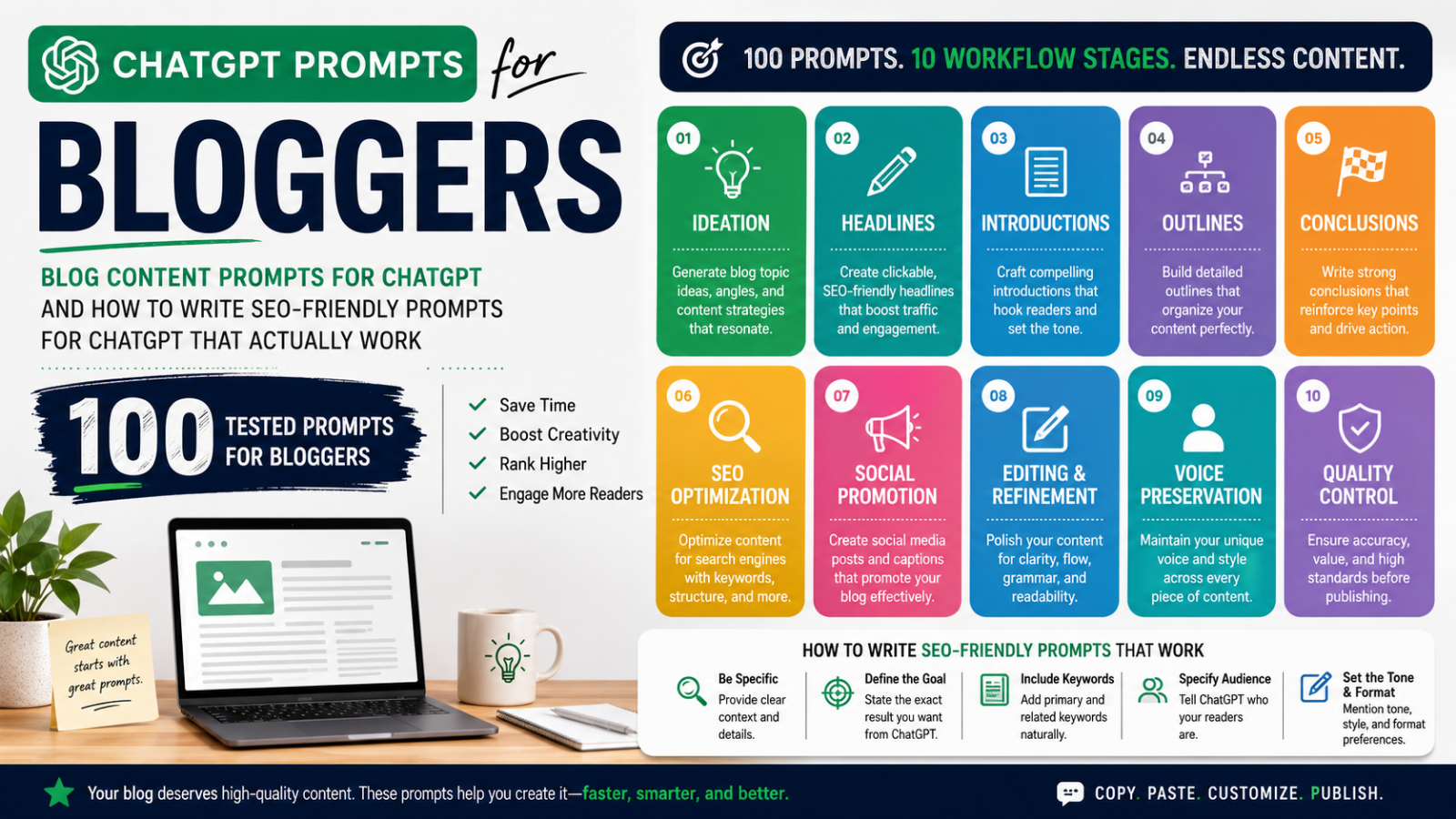
This guide provides 100 tested ChatGPT prompts for bloggers organized by workflow stage — ideation, headlines, introductions, outlines, conclusions, SEO optimization, social promotion, editing, voice preservation, and quality control. Each prompt is structured for immediate use in a real editorial workflow.
It was a rainy Wednesday afternoon. The editorial calendar said “publish Tuesday.” It was already Thursday. A topic existed — but no angle, no hook, and absolutely no energy to find one.
That was the moment ChatGPT prompts for bloggers stopped being optional and became essential.
Not as a shortcut. Not as a replacement for human voice. As a creative ignition switch — the tool that compresses the gap between stuck and writing to under ten minutes.
This guide is the result of over 100 prompts tested in real editorial workflows, refined for clarity, and organized exactly where you need them in the writing process. Every prompt follows the same principle: AI provides the structure and speed. You provide the expertise and authority.
⚠️ Editorial Rule: Always treat ChatGPT output as a first draft. Fact-check every claim. Add first-hand experience. Publish nothing raw.
Why Should Every Blogger Use ChatGPT Prompts in Their Content Workflow?
Direct Answer: Bloggers use ChatGPT prompts to compress execution time on high-effort tasks — brainstorming, outlining, editing — by 3 to 5 hours per article. When properly prompted and editorially reviewed, AI-assisted content performs comparably to fully manual content in organic search rankings.
What the Data Shows About AI-Assisted Blogging
| Metric | Finding | Source |
|---|---|---|
| Time saved per article | 3–5 hours average on research and drafting | HubSpot State of Marketing, 2024 |
| Search performance | AI-assisted content performs comparably when properly edited | Search Engine Journal, 2024 |
| Marketer satisfaction | 72% say AI improved production scale without reducing quality | Content Marketing Institute, 2024 |
What Makes ChatGPT Prompts for Bloggers Different From Generic AI Use
- Generic AI use: Vague instructions → generic output → unusable drafts
- Structured blog prompts: Role + goal + context + format → targeted output → editable drafts
- The distinction that matters: ChatGPT accelerates the cognitive overhead. The blogger provides lived experience, expert judgment, and authentic voice.
How Do You Write SEO‑Friendly Prompts for ChatGPT That Actually Work?
Direct Answer: To write SEO-friendly prompts for ChatGPT, include four elements in every instruction: a defined role, a specific goal, audience and keyword context, and a required output format. This four-part structure transforms vague AI responses into strategically aligned, SEO-ready content drafts.
The 4-Part Prompt Formula Every Blogger Needs
| Element | Purpose | Example |
|---|---|---|
| Role | Define who ChatGPT is in this task | “Act as an experienced SEO content strategist…” |
| Goal | Specify the exact deliverable | “…write a 10-section content outline…” |
| Context | Provide keyword, audience, and tone | “…for beginners targeting the keyword [keyword]…” |
| Format | State the output structure | “…as numbered H2 headings with one-sentence descriptions.” |
What SEO-Specific Prompts Must Always Include
- ✅ The target keyword stated explicitly in the prompt
- ✅ The search intent type: informational, transactional, commercial, or navigational
- ✅ The audience knowledge level: beginner, intermediate, or expert
- ✅ The desired output format: table, list, paragraph, outline, or comparison
Expert Note: Learning how to write SEO-friendly prompts for ChatGPT is a compounding skill. Each refined prompt you create becomes a reusable asset in your editorial workflow.
What Are the Best Blog Content Prompts for ChatGPT to Generate Endless Topic Ideas?
Direct Answer: The best blog content prompts for ChatGPT topic ideation specify niche, target audience, search intent (informational vs. transactional), and angle type (evergreen, contrarian, data-driven, seasonal). These constraints produce targeted, low-competition topic ideas faster than any manual brainstorming method.
Prompts 1–10: Topic Ideation
| # | Prompt | Best Use Case |
|---|---|---|
| 1 | “Generate 20 blog post ideas for [niche] targeting beginners who want to [goal]. Focus on informational intent with low-to-medium competition.” | New site, thin content areas |
| 2 | “List 15 evergreen blog topics for [niche] that stay relevant for 3+ years. Include a one-sentence angle for each.” | Authority building |
| 3 | “Give me 10 contrarian blog post ideas in [niche] that challenge common advice with defensible angles.” | Differentiation strategy |
| 4 | “What are 10 blog topics in [niche] with high search demand that are rarely covered with real depth or original research?” | Gap content strategy |
| 5 | “Generate 12 data-driven blog post ideas for [niche] that cite original studies, surveys, or industry reports.” | E-E-A-T content building |
| 6 | “List 10 personal story-based blog topics for [niche] combining first-hand experience with actionable advice.” | Trust and relatability |
| 7 | “What are 10 ‘complete guide’ topics in [niche] a reader would bookmark and return to repeatedly?” | Pillar content strategy |
| 8 | “Generate 8 comparison post ideas: [Tool A] vs [Tool B] in [niche] from the perspective of [audience type].” | Commercial intent keywords |
| 9 | “Give me 10 seasonal blog ideas for [niche] for Q4 targeting [audience] in a buying or planning mindset.” | Seasonal content calendar |
| 10 | “List 10 problem-solving blog topics in [niche] addressing the top frustrations of [audience] based on forum and Reddit questions.” | Bottom-of-funnel content |
What ChatGPT Prompts Help Bloggers Write Click-Worthy Headlines That Rank?
Direct Answer: The best ChatGPT headline prompts specify the target keyword, required power words, number-based formats, audience type, and emotional trigger style. Requesting 8–10 variations — mixing curiosity, benefit, and urgency framing — gives bloggers testable options to optimize click-through rate.
Prompts 11–20: Headline Writing
- “Write 10 headline variations for [topic] targeting [keyword]. Use power words, numbers, and emotional triggers. Mix curiosity-driven and benefit-driven styles.”
- “Write 5 how-to headlines for [topic] targeting [audience]. Promise a clear, specific, achievable outcome in each.”
- “Generate 8 listicle headlines for [topic] using odd numbers.” (Research note: odd-numbered listicles statistically outperform even numbers in CTR — CoSchedule Headline Analyzer data, 2023)
- “Create 5 question-based headlines for [topic] that match conversational voice-search query patterns.”
- “Rewrite this headline to be more specific and benefit-driven: [paste headline].”
- “Write 5 urgency-based headlines for [topic] that create timely relevance without clickbait.”
- “Generate 6 contrarian headlines for [topic] that challenge a widely held belief in [niche].”
- “Write 3 SEO-optimized headlines for [topic] that include [keyword] naturally and stay under 60 characters.”
- “Give me 5 ‘ultimate guide’ headlines for [topic] that signal comprehensive, authoritative coverage.”
- “Rewrite these 5 weak headlines to be sharper, more specific, and emotionally resonant: [paste headlines].”
How Do Blog Content Prompts for ChatGPT Help You Write Introductions That Keep Readers on the Page?
Direct Answer: Blog content prompts for ChatGPT write stronger introductions by specifying the hook type (scenario, statistic, question, PAS formula), the audience pain point, and the credibility signal needed. The first 100 words of an article are the primary driver of bounce rate — making this the highest-ROI prompt category.
Prompts 21–30: Introduction Writing
| # | Prompt | Hook Type Used |
|---|---|---|
| 21 | “Write a 100-word intro for [topic] targeting [audience]. Open with a relatable scenario, connect to the primary pain point.” | Scenario-based |
| 22 | “Write 3 intro variations for [topic]: one uses a shocking statistic, one a contrarian statement, one a short personal story.” | Multi-angle testing |
| 23 | “Create an intro for [topic] that opens with a direct question the reader is already asking themselves.” | Question hook |
| 24 | “Write an intro for [topic] using the PAS formula: Problem → Agitate → Solution.” | Copywriting framework |
| 25 | “Write a 120-word intro for [topic] that establishes author credibility within the first three sentences.” | E-E-A-T opening |
| 26 | “Write an intro for [topic] that opens with a bold, counterintuitive claim then immediately backs it up.” | Contrarian hook |
| 27 | “Write an intro for [topic] using a brief analogy to make a complex concept immediately accessible to beginners.” | Analogy hook |
| 28 | “Create an intro for [topic] that clearly states what the reader will learn and why it matters to them specifically.” | Direct benefit hook |
| 29 | “Write a 90-word intro for [topic] that feels conversational and warm — a knowledgeable friend, not a corporate brand.” | Voice/tone alignment |
| 30 | “Rewrite this intro to be more engaging, more specific, and less generic: [paste intro].” | Editorial improvement |
What Is the Best Way to Use ChatGPT Prompts for Bloggers to Build SEO Content Outlines?
Direct Answer: The best ChatGPT outlining prompts include the target keyword, audience knowledge level, content type (pillar, listicle, comparison, case study), and a request for H2/H3 structure with section descriptions. A complete brief-level outline from ChatGPT takes under two minutes and guides the entire writing session.
Prompts 31–40: Content Outlining
- “Create a full SEO outline for [topic] targeting [keyword]. Include H1, 8–10 H2s, 2–3 H3s per section. Add a one-sentence description per section.”
- “Generate a content outline for [topic] for beginners. Logical flow: problem → context → solution → action.”
- “Create a pillar content outline for [topic] that supports 10 cluster articles. List pillar sections and the cluster topic each H2 could spawn.”
- “Build a comparison outline: [Option A] vs [Option B]. Include overview, key differences, pros and cons, and a clear recommendation section.”
- “Create a 15-item listicle outline for [topic]. Per item: name, 2-sentence explanation, and a practical example.”
- “Generate a data-driven article outline for [topic]. Include sections for key statistics, expert context, practical implications, and a summary table.”
- “Create a case study outline for [result achieved]: background, challenge, strategy, execution, results, and key takeaways.”
- “Build a FAQ-style outline for [topic] using 12 questions matching common voice-search and long-tail query patterns.”
- “Create a ‘complete guide’ outline for [topic] targeting a high-competition keyword. Include a table of contents structure.”
- “Review this outline and suggest improvements for SEO comprehensiveness, logical flow, and E-E-A-T signals: [paste outline].”
How Can You Use ChatGPT Prompts for Bloggers to Write Conclusions That Drive Real Reader Action?
Direct Answer: ChatGPT conclusion prompts perform best when they specify a summary structure (3 key takeaways), a callback element to the opening, a clear CTA type, and a target word count. Most blog conclusions underperform because they summarize without directing — these prompts fix that directly.
Prompts 41–50: Conclusion Writing
| # | Prompt | Strategic Function |
|---|---|---|
| 41 | “Write a 100-word conclusion for [topic]. Summarize 3 key takeaways, reinforce the main benefit, end with a specific actionable CTA.” | Standard close |
| 42 | “Write a conclusion using a callback to the opening story or scenario from the introduction.” | Narrative continuity |
| 43 | “Create a conclusion for [topic] ending with an open question designed to invite reader comments.” | Engagement driver |
| 44 | “Write a conclusion for [topic] including a subtle internal link prompt to [related article].” | Internal linking |
| 45 | “Write a motivational conclusion for [topic] that leaves readers feeling empowered to take the first step immediately.” | Action catalyst |
| 46 | “Create a conclusion for [topic] reinforcing author credibility and inviting readers to explore more content or subscribe.” | Authority + retention |
| 47 | “Write 3 conclusion variations: 50-word punchy, 100-word summary, 150-word with next steps.” | A/B testing |
| 48 | “Rewrite this conclusion to be more specific, more actionable, and more memorable: [paste conclusion].” | Editorial polish |
| 49 | “Write a conclusion for [topic] that transitions naturally into a product or service recommendation without feeling salesy.” | Monetization bridge |
| 50 | “Create a conclusion using a powerful final statistic or insight to leave a lasting impression.” | Authority close |
What Are the Most Effective SEO-Friendly ChatGPT Prompts for On-Page Optimization?
Direct Answer: The most effective SEO-friendly ChatGPT prompts for on-page optimization request semantic keyword clusters, meta tag variations, search intent classification, image alt text, schema markup recommendations, and featured snippet formatting. These prompts bridge content strategy with technical SEO in a single workflow.
Prompts 51–60: On-Page SEO Optimization
| # | Prompt | SEO Function |
|---|---|---|
| 51 | “Suggest 15 semantic and LSI keywords for an article targeting [primary keyword] for [audience]. Group by section relevance.” | Topical authority |
| 52 | “Write 5 meta title and description pairs for [topic], keyword [keyword]. Titles ≤60 chars, descriptions ≤160 chars with CTAs.” | CTR optimization |
| 53 | “Classify search intent for these 10 keywords: [paste]. Explain each as informational, transactional, commercial, or navigational.” | Intent mapping |
| 54 | “Suggest internal linking opportunities for [topic] on a site covering [niche]. List anchor text phrases and rationale.” | Link equity flow |
| 55 | “Generate 10 FAQ questions and brief answers for [topic] targeting voice-search and featured snippet opportunities.” | Featured snippets |
| 56 | “Write keyword-aware image alt text for 5 images in an article about [topic]. Each under 125 characters.” | Image SEO |
| 57 | “Suggest schema markup types for a [page type] targeting [keyword]. Explain the SEO benefit of each.” | Rich results |
| 58 | “Rewrite this paragraph for readability and keyword integration: [paste]. Target keyword: [keyword]. Reading level: Grade 8.” | Readability + SEO |
| 59 | “Analyze this heading structure and suggest improvements for SEO, flow, and featured snippet optimization: [paste headings].” | Structure audit |
| 60 | “Write a 300-word ‘Key Takeaways’ box for [topic] structured to be extracted as a Google featured snippet.” | Snippet targeting |
How Do You Use ChatGPT Prompts for Bloggers to Repurpose and Promote Content Across Social Platforms?
Direct Answer: Use ChatGPT social promotion prompts by specifying the platform, audience type, desired action (click, comment, share), tone, and format constraints. Requesting multiple variations per platform (3–5 options) gives you testable content for systematic distribution without writing each post manually.
Prompts 61–70: Content Distribution and Social Promotion
| Platform | Prompt | Format Goal |
|---|---|---|
| 61. “Write 5 LinkedIn post variations promoting [topic]. Mix personal insight, a key statistic, and a clear link CTA.” | Professional audience | |
| Twitter/X | 62. “Create 3 Twitter/X thread outlines for [topic]. Each thread: 6–8 tweets, bold hook opening.” | Engagement threading |
| 63. “Write 5 Instagram captions for [topic]. Tone: conversational and motivating. Include 3 relevant hashtag groups.” | Reach + discovery | |
| 64. “Create a Pinterest pin description for [topic]. Include the primary keyword naturally, under 200 characters.” | Search-led traffic | |
| 65. “Write a Facebook post for [topic] for a community of [audience type]. Focus on conversation, not just link clicks.” | Community engagement | |
| 66. “Generate 5 email subject lines for [topic] subscriber list of [audience]. Mix curiosity, benefit, and urgency.” | Open rate optimization | |
| Newsletter | 67. “Write a 150-word email newsletter intro promoting [topic]. Warm, personal, benefit-forward.” | Subscriber retention |
| Short-form video | 68. “Create 3 × 15-second video script hooks for [topic] for TikTok or Instagram Reels.” | Short-form video |
| Community posts | 69. “Write 5 conversation-starter social posts for [topic] designed for comments and shares over link clicks.” | Organic reach |
| Content atomization | 70. “Repurpose this blog section into a standalone social post with a clear takeaway and article link: [paste section].” | Content repurposing |
What ChatGPT Prompts for Bloggers Improve Editing, Clarity, and Content Quality?
Direct Answer: ChatGPT editing prompts improve blog content quality by targeting specific weaknesses: passive voice, vague claims, repetition, weak transitions, and poor readability. Unlike generic editing requests, these prompts ask for scored evaluations and concrete rewrites — making revision cycles faster and more precise.
Prompts 71–80: Editing, Revision, and Quality Improvement
- “Review this section for clarity, specificity, and logical flow. Suggest three concrete improvements: [paste section].”
- “Rewrite this paragraph 30% shorter without losing any key information: [paste paragraph].”
- “Identify vague or unverified claims in this article. Suggest how to strengthen each with a specific source or example: [paste article].”
- “Check for passive voice. Rewrite passive sentences in active voice without changing meaning: [paste section].”
- “Rate this section’s readability 1–10, explain the score, and suggest specific edits: [paste section].”
- “Find the weakest heading in this article. Rewrite it to be more specific, benefit-driven, and search-intent aligned: [paste headings].”
- “Suggest five places to add a real-world example, statistic, or expert quote to strengthen authority: [paste article].”
- “Rewrite this section in a more conversational tone without reducing informational value: [paste section].”
- “Identify repetitive phrases or ideas in this draft. Suggest how to eliminate or consolidate them: [paste draft].”
- “Write a stronger transition sentence between these two paragraphs to improve narrative flow: [paste paragraphs].”
How Do You Use Blog Content Prompts for ChatGPT Without Losing Your Authentic Writing Voice?
Direct Answer: Preserve your authentic voice in AI-assisted blog content by providing ChatGPT with a voice guide sample from your existing writing, then requesting rewrites that match that specific tone. AI produces statistically average language by default — your job is to use prompts that break that average intentionally.
The Core Problem With Raw AI Output
“AI, by its nature, produces statistically average language. Your job as a blogger is to break that average.”
This is the honest conversation most AI guides skip. Every blogger’s real competitive advantage is voice — and generic prompts erase it.
Prompts 81–90: Voice Preservation and Authenticity
| # | Prompt | Voice Function |
|---|---|---|
| 81 | “Rewrite this section in the brand voice described here: [paste voice guide]. Keep all information intact: [paste section].” | Voice alignment |
| 82 | “Identify phrases that sound generic or AI-generated. Suggest specific, human-sounding alternatives: [paste article].” | De-genericizing |
| 83 | “Write a personal anecdote opener for [topic] based on this real experience: [briefly describe].” | Experience signal |
| 84 | “Add first-person perspective and specific detail to make this section feel more authentic: [paste section].” | E-E-A-T: Experience |
| 85 | “Suggest 3 places to add a personal opinion or contrarian position to differentiate this content: [paste article].” | Editorial POV |
| 86 | “Rewrite this conclusion to sound like someone who genuinely cares about the reader’s outcome: [paste conclusion].” | Reader trust |
| 87 | “Here is a writing sample from my blog: [paste excerpt]. Rewrite this AI-generated section to match that voice: [paste section].” | Style matching |
| 88 | “Find generic filler phrases (‘in conclusion,’ ‘it is worth noting,’ ‘in today’s world’) and replace with purposeful language: [paste article].” | Filler elimination |
| 89 | “Write a 50-word author’s note revealing something specific and genuine about why this topic matters to me personally.” | Author presence |
| 90 | “Rewrite this list as a narrative paragraph with a strong point of view, turning data points into a genuine argument: [paste list].” | Voice amplification |
What Quality Control ChatGPT Prompts Should Every Blogger Use Before Publishing?
Direct Answer: Before publishing any AI-assisted blog post, run it through ChatGPT quality control prompts that check factual accuracy, E-E-A-T signals, keyword stuffing, trust signal gaps, and schema eligibility. This 10-prompt editorial checklist catches errors that human review alone frequently misses.
Prompts 91–100: Quality Control, Fact-Checking, and Pre-Publish Audit
| # | Prompt | Risk Addressed |
|---|---|---|
| 91 | “Fact-check these five claims. Flag any that may be inaccurate, outdated, or unverifiable: [paste claims].” | Hallucination / accuracy |
| 92 | “What questions would a skeptical reader ask about this article? List 8 objections and how to address each: [paste article].” | Credibility gaps |
| 93 | “Identify sections lacking supporting evidence. Suggest what source type would strengthen each: [paste article].” | E-E-A-T: Authoritativeness |
| 94 | “Review this article for E-E-A-T signals. What is missing? How would a Google quality rater evaluate it? Suggest 3 improvements.” | Google quality standards |
| 95 | “Check for keyword stuffing. Highlight unnatural [keyword] appearances and suggest natural rewrites: [paste article].” | Over-optimization penalty |
| 96 | “Suggest a ‘Trust Signals’ checklist — author bio, sources, publish date, update note — to increase reader and search engine trust.” | Trustworthiness signals |
| 97 | “Review the internal link strategy. Are anchor texts natural? Are linked topics genuinely relevant? Suggest improvements.” | Link quality audit |
| 98 | “Evaluate this article’s depth compared to a typical top-10 result for [keyword]. What is missing that top-ranking articles likely include?” | Competitive content gap |
| 99 | “Suggest a structured data and schema strategy for this article to maximize featured snippet and rich result eligibility.” | SERP feature targeting |
| 100 | “Write a 10-item pre-publish editorial checklist for AI-assisted blog posts covering quality, accuracy, and E-E-A-T compliance.” | Full workflow closure |
Frequently Asked Questions: ChatGPT Prompts for Bloggers
Are ChatGPT prompts for bloggers suitable for every niche and industry?
Yes — universally applicable across niches including personal finance, health, technology, travel, and food. The prompt frameworks remain consistent; what changes is the context you inject: niche terminology, audience demographics, keyword targets, and brand voice. Specificity of context is the only variable that changes output quality across niches.
How are blog content prompts for ChatGPT different from generic AI prompts?
Blog content prompts for ChatGPT are built for four publishing-specific goals: SEO keyword alignment, audience targeting, editorial readiness, and brand voice consistency. Generic prompts lack role definition, context, and format specifications — producing general output with no clear publishing application. Structured blog prompts produce editable, on-brand drafts.
Can I use these ChatGPT prompts to write a complete blog article from scratch?
Yes, but with editorial requirements. Use prompts for every component — ideation, outline, intro, body sections, meta tags, conclusion. However, never publish raw AI output. The mandatory steps before publishing are: fact-checking all claims, adding first-hand expertise, verifying statistics against primary sources, and editorial voice refinement.
How do I learn to write SEO-friendly prompts for ChatGPT that improve Google rankings?
Four elements are non-negotiable in every SEO prompt:
- Target keyword stated explicitly
- Search intent type (informational, transactional, commercial, navigational)
- Audience knowledge level (beginner, intermediate, expert)
- Output format (table, list, outline, or paragraph)
Always validate keyword suggestions, meta tags, and schema recommendations in a dedicated SEO tool (Ahrefs, Semrush, or Google Search Console) — ChatGPT does not have access to live search data.
How many ChatGPT prompts should I use per article to maintain quality?
6–10 prompts per article is the optimal workflow range:
- 1 for ideation
- 1 for the outline
- 1 for the introduction
- 2–3 for body section drafts
- 1 for meta tags
- 1 for SEO review
- 1 for final editing
The remaining prompts in this guide are available for specific situations as needed.
Do these ChatGPT prompts for bloggers work with Claude, Gemini, or Perplexity?
Yes — cross-platform compatible. While framed around ChatGPT, every prompt in this guide works effectively with Claude (Anthropic), Google Gemini, Perplexity AI, and other large language models. The structural principles — role, goal, context, format — apply universally. Model-specific behavior differences are minor compared to prompt quality differences.
How do I protect E-E-A-T standards when using blog content prompts for ChatGPT?
E-E-A-T compliance requires human augmentation on every AI-assisted article. The four mandatory additions:
- First-hand experience (personal anecdote, case study, or direct outcome)
- Authoritative citations (linked to primary or peer-reviewed sources)
- Visible author credentials (author bio with relevant qualifications)
- Clearly sourced statistics (no unverified data points published)
E-E-A-T signals come from human expertise layered onto AI structure — never from AI output alone. (Source: Google Search Quality Evaluator Guidelines, Section 3.2)
What is the single biggest mistake bloggers make with ChatGPT prompts?
Publishing vague-prompt output without editing — the most common and most costly error. “Write a blog post about SEO” produces generic, uneditable content. A detailed four-part prompt produces a structured draft. And even the strongest draft requires human editing, fact-checking, and voice refinement before it reflects your actual expertise and earns rankings.
How often should I update and refine my ChatGPT prompts for bloggers?
Every 3–6 months. As AI models update, prompt patterns shift in effectiveness. Best practice:
- Track which prompts consistently produce high-quality, usable output
- Note any prompts that produce degraded results after model updates
- Build a personal library of your top 20 highest-performing prompts
- Review and refine the full library at each major model release
Can complete beginners use these ChatGPT prompts for bloggers effectively right away?
Yes — designed for immediate use at any skill level. For beginners, the highest-value starting points are:
- Ideation prompts (1–10): eliminate blank-page paralysis
- Outline prompts (31–40): provide article structure instantly
- Meta tag prompts (52): produce publish-ready SEO elements
As editorial confidence grows, the SEO optimization, editing, and voice refinement prompts compound in value.
Start With Five. Build From There.
You now have 100 tested, workflow-organized ChatGPT prompts for bloggers — covering every stage from blank page to published, optimized article.
The core principle that makes this work:
Human expertise + Strategic prompting + Editorial discipline + E-E-A-T augmentation = Content that ranks and builds lasting authority.
Your Three-Step Start
- Pick a category — ideation, outlines, or meta tags
- Run your first five prompts with full four-part structure (role + goal + context + format)
- Apply the pre-publish checklist (prompts 91–100) before every publication
Each refined prompt becomes a reusable workflow asset. Each well-edited article compounds your topical authority. The cursor is no longer blinking at a blank page.
It is waiting for your next great idea.