
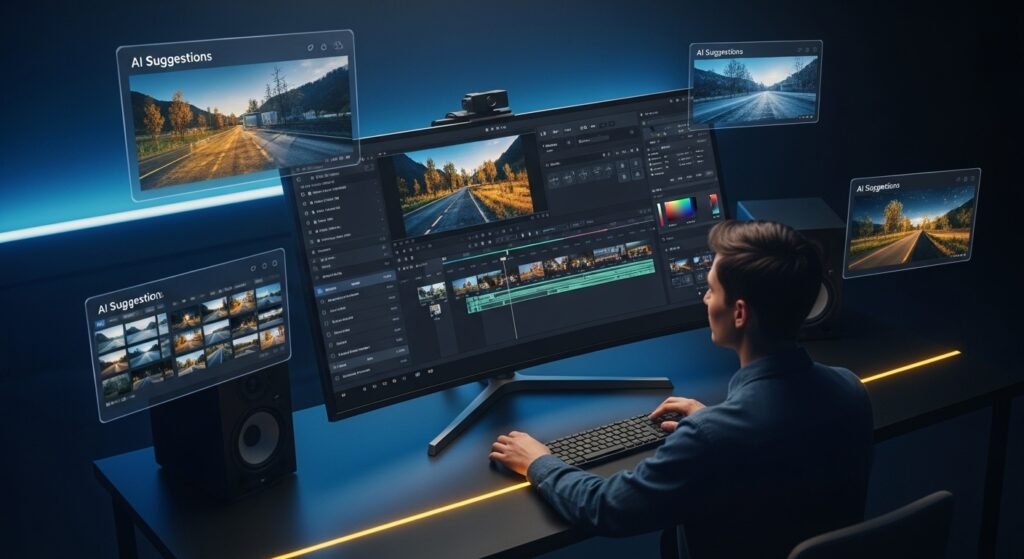
Video editing used to be a job that took a lot of time. You had to sit and look through videos for hours to get everything right.. Now video editing is much easier because of artificial intelligence. Artificial intelligence has changed video editing into an automatic process. Whether you are new to making videos. Want to make a YouTube Short or you are a professional video editor who works with big companies and movie studios artificial intelligence tools can help you get professional results quickly. You can get results in just a few minutes instead of waiting for days.
New video editing tools that use intelligence can do a lot of things to help you. These artificial intelligence video editors can write down what people are saying in a video automatically cut out parts that are not needed add captions make background videos copy peoples voices remove backgrounds and even create special effects.. The best part is that you are still in control of the video. People who make videos have seen improvements since they started using these artificial intelligence tools. In fact by 2026 people who used these tools were able to finish their work five to ten times faster. They also saved a lot of money. Between 40 and 70 percent less on costs after filming. Tools like Descript, CapCut, Runway and Adobe Premiere Pro with Firefly are now commonly used by people who make podcasts, market products make movies and create content for media.
This guide will show you the artificial intelligence tools for video editing that you can use right now. It will also give you a step-, by-step plan to follow, advanced tips, best practices, common mistakes to avoid and real-life examples. By the time you finish reading this guide you will know which artificial intelligence tools to use and how to add them to your video editing process. This is true whether you are just starting out or if you are already making a lot of videos.
Why AI Has Revolutionized Video Editing
Traditional video editing used to require a lot of knowledge about software like Premiere or Final Cut. It also took a lot of time to do the things over and over. For example video editing demanded time to remove filler words from videos, sync captions with the audio find the B-roll footage and make sure the audio sounds good. Now video editing is different because Artificial Intelligence or AI can do these tasks for us. At the time Artificial Intelligence or AI helps us be more creative, with special features that can generate new things.
Key advantages include:
- Speed and Efficiency: Text-based editing, auto-highlight detection, and one-click repurposing.
- Accessibility: Beginners can produce broadcast-quality videos without years of training.
- Consistency and Scalability: Perfect captions, brand-safe assets, and multi-platform exports.
- Creative Power: Generative fill, motion effects, and image-to-video turn raw footage into cinematic results.
- Cost Savings: Reduce reliance on large editing teams or stock libraries.
The line between video generation and editing has blurred. Tools now combine both, letting you start from a script, raw clips, or even a text prompt.
The Best AI Tools for Video Editing in 2026
Here is a curated selection of the top-performing tools based on real-world testing, user feedback, and feature depth in 2026:
- Descript – Best for text-based editing and podcasts/talking-head videos
Edit video by editing text. Automatic transcripts, Overdub voice cloning, filler-word removal, and AI eye-contact correction. Ideal for interviews and long-form content.
Pricing: Free tier; Creator $12–16/month; Pro $24/month.
Best for: Beginners to pros working with dialogue-heavy footage. - CapCut – Best free/affordable option for short-form social media
Mobile-first with powerful AI auto-captions, effects, transitions, B-roll suggestions, and script-to-video. Seamless TikTok/Instagram integration.
Pricing: Free with Pro at $7.99/month.
Best for: Content creators and marketers needing fast, viral-ready clips. - Adobe Premiere Pro (with Sensei AI + Firefly) – Best professional-grade editor
Industry-standard timeline with AI smart scene detection, auto-reframe, Morph Cut, generative fill, and now integrated Runway Gen-4.5 for text-to-video and image-to-video.
Pricing: Starts at $22.99/month (Creative Cloud).
Best for: Filmmakers and agencies already in the Adobe ecosystem. - Runway ML – Best for generative AI editing and creative effects
Text-to-video, image-to-video, background removal, object inpainting, motion tracking, and Gen-4.5 models. Turns static assets into dynamic footage or applies cinematic effects.
Pricing: From $12/user/month.
Best for: Creative professionals pushing visual boundaries. - Opus Clip – Best for repurposing long videos into shorts
AI analyzes long-form content and extracts viral clips with captions, scoring, and B-roll suggestions.
Pricing: Subscription-based (competitive with similar tools).
Best for: YouTubers and podcasters scaling social content. - Vizard.ai – Best for long-to-short conversion workflows
Excels at turning webinars, podcasts, or long videos into multiple viral shorts with smart clipping and editing.
Best for: Marketing teams and educators. - DaVinci Resolve AI – Best all-in-one professional suite (free option)
Advanced color grading, audio cleanup, auto-editing, and AI tools in a full-featured editor.
Pricing: Free version available; Studio paid.
Best for: Filmmakers needing Hollywood-level tools. - Submagic / Captions.ai – Best for quick captioning and polish
Stunning animated captions, eye-contact fixes, and short-clip enhancement. Often used alongside other editors.
Other strong mentions: Reap (all-in-one repurposing), Movavi and Filmora (beginner-friendly), and Kling/PixVerse (for generation-heavy workflows).
Step-by-Step Guide: Professional AI Video Editing Workflow
Follow this proven process used by top creators in 2026:
Step 1: Prepare Your Content (5–10 minutes)
Upload raw footage or start with a script. Use AI transcription tools (built into Descript or CapCut) for instant text.
Step 2: Choose Your Primary Editor
- Dialogue-heavy? → Descript (edit by text).
- Short social clips? → CapCut.
- Full cinematic project? → Premiere Pro or DaVinci Resolve.
Step 3: Let AI Handle the Heavy Lifting
- Remove filler words and silences automatically.
- Generate captions, B-roll, and transitions.
- Use generative tools (Runway/Firefly) to create or enhance scenes with prompts like: “Add subtle cinematic fog and dynamic camera pan to this shot.”
Step 4: Refine Creatively
- Apply motion effects, color grading, or AI eye-contact fixes.
- Test multiple variations quickly.
Step 5: Export and Optimize
- Auto-reframe for different platforms (square, vertical, horizontal).
- Add alt text, subtitles, and metadata.
- Publish directly to YouTube, TikTok, or LinkedIn.
Advanced Techniques for Professional Results
- Text-to-Video + Editing Hybrid: Start in Runway or Firefly to generate missing B-roll, then import into Descript or Premiere.
- Multi-Model Workflows: Use Kling or PixVerse for realistic motion, then CapCut for final assembly.
- AI Prompt Engineering for Effects: In Runway, use detailed prompts: “Apply smooth slow-motion tracking shot with film grain, in the style of cinematic 35mm.”
- Batch Repurposing: Feed one long video into Opus Clip or Vizard to generate 10–20 ready-to-post shorts.
- Voice Cloning and Dubbing: Descript’s Overdub or integrated tools for multilingual versions.
- Self-Refine Loops: After AI edit, ask the tool (or a secondary AI) to “critique pacing and suggest improvements.”
Best Practices for Stunning Results
- Always start with a clear brief or script—AI performs best with structure.
- Combine AI (70–80% of the work) with human oversight for final creative decisions.
- Test outputs on target platforms and devices.
- Maintain brand consistency with custom styles, color palettes, and voice profiles.
- Version your projects—AI changes are fast, so track iterations.
- Prioritize commercial licensing (Firefly and Runway offer safe options for paid work).
- Learn core editing principles (pacing, cuts, audio levels) to guide AI effectively.
Common Pitfalls to Avoid
- Over-relying on AI without review (results can feel generic or have minor artifacts).
- Using vague prompts in generative tools.
- Ignoring platform-specific requirements (e.g., vertical video for TikTok).
- Neglecting audio quality—AI cleans it well, but manual checks are still essential.
- Choosing the wrong tool for your use case (e.g., Runway for simple cuts is overkill).
Real-World Applications
- Content Creators & YouTubers: CapCut + Opus Clip for daily shorts from long videos.
- Podcasters: Descript for effortless episode editing and clips.
- Marketing Teams: Premiere Pro + Firefly for branded campaigns with consistent assets.
- Filmmakers: Runway + DaVinci Resolve for VFX-heavy or experimental projects.
- Businesses: Vizard or Reap to repurpose webinars into social proof.
Many teams now operate with one editor + AI handling what used to require a full post-production crew.
The Future of AI Video Editing
By the end of 2026 and after that we can expect to see more things working together seamlessly. For example artificial intelligence agents will be able to edit series of videos or shows from just one idea and people will be able to work together with artificial intelligence in real time. The artificial intelligence will also be able to understand and work with types of media like video and audio and 3D models.
The tools will become more aware of the situation. Automatically use the guidelines that are specific, to your brand. The main thing that will always be important is creativity and the way people tell stories. The artificial intelligence is just going to make the boring parts easier so people can focus on being creative and telling stories.
Conclusion
Video editing tools that use intelligence are really changing the way people make videos. Now anyone can make videos that look very professional in an amount of time. Even people who are very good at video editing can work faster. Make more videos than they ever could before. To get started you should begin with one tool, like Descript or CapCut. Try it out with a video you made recently. Then you use the intelligence in the tool to edit the video. You will be surprised at how good the video looks when you are done.
It is easier, than ever to make videos that people want to watch. If you learn how to use these video editing tools and get better at using them you will be able to make videos and stay ahead of everyone else who is making videos.