
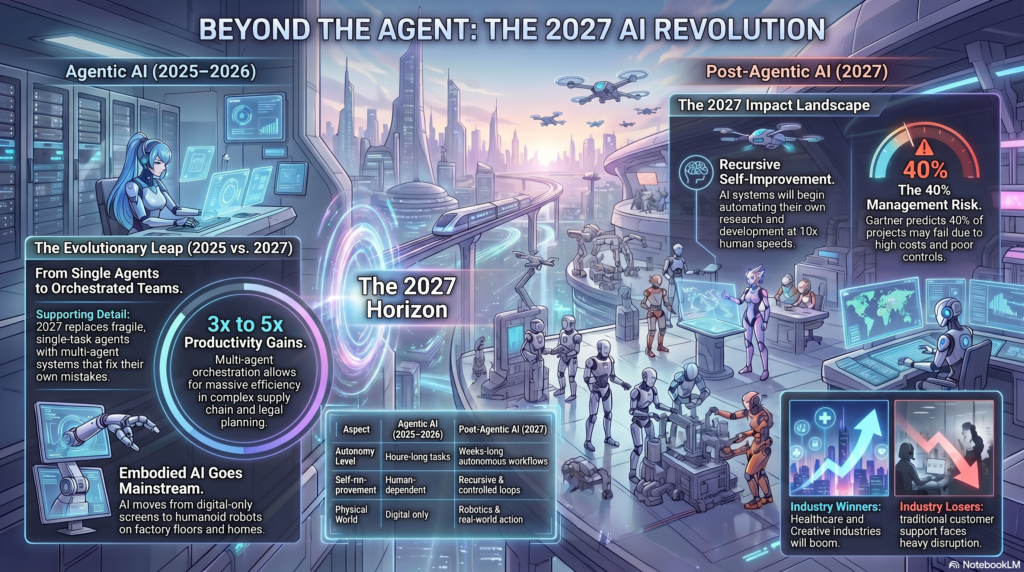
Agentic AI was a deal in 2025 and 2026. These systems that could plan and use tools to do many tasks felt like a game-changer.
But by 2026, people started to see the reality: Gartner said that over 40% of agentic AI projects might get canceled by the end of 2027 because they were too expensive, didn’t give clear results, and had poor risk controls.
The smartest leaders are not giving up.
Sam Altman, Demis Hassabis, and Dario Amodei all think that 2026 and 2027 are when we move from AI agents to something much more powerful:
- Intelligence that works together on a big scale
- AI that can interact with the physical world
- And AI that can even improve itself.
Here are seven predictions for what’s next for AI in 2027.
These are based on reports from Gartner, Deloitte, and McKinsey, as well as statements from CEOs and real AI deployments in 2026. This is not science fiction. The next phase of AI is already happening in labs and boardrooms. It is the future of AI and its applications. The development of AI will continue to shape the industry.
The Agentic AI Era in Hindsight
Let us be honest: intelligence that can act on its own, which is what we call agentic AI really delivered. From computer programs that can code by themselves to customer service robots that can handle tasks, the year 2025 felt like the year of agentic AI. These models started using tools, remembering things, and working on tasks that took hours to complete.
It did not take long to see the limitations of agentic AI.
- Single agentic AI fragility was a problem. If one part of the system made a mistake or a tool failed, the whole process would fall apart.
- Agentic AI could not really work together. They could not discuss things, become experts in areas, or correct their own mistakes like a team of people can.
- Agentic AI was only good for working with computers. It was not useful in places like factories, warehouses, or homes.
- Agentic AI could not improve itself. It still needed people to constantly teach it and watch over it.
These are the gaps that the year 2027 will fix. The change is not about making agentic AI smarter; it is about moving from tools to systems that work together, can think for themselves, and can change and improve on their own.
The 7 Big Predictions for AI in 2027
1. Teams of Artificial Intelligence Are Now the Way to Go
Single agents are no longer being used. AI teams are what people are utilizing now.
By the middle of 2027, companies will be using multi-agent systems where specialized agents discuss options, share work, and fix mistakes as they happen. Deloitte’s 2026 TMT Predictions already state that “agent orchestration” is the key to obtaining significant value, and open protocols like MCP are becoming standard in the industry.
We can observe this trend in the world today: Google DeepMind and other companies are already supporting MCP for Gemini models. Some early tests indicate that we can accomplish 3 to 5 times more work in complicated tasks like planning for supplies or reviewing legal contracts.
By 2027, we can expect to see this by the third quarter. We will have “AI departments” where one AI agent finds customers, another AI agent writes proposals, and a third AI agent checks to ensure everything is legal—all without needing people to get involved.
For example, a marketing team initiates a campaign. The strategy AI agent analyzes trends, the creative AI agent creates ads, the analytics AI agent tests to see what works best over time, and the optimization AI agent adjusts the budget daily.
2. Embodied AI Goes Mainstream
Agentic brains are now meeting real-world bodies.
The year 2027 is when humanoid robots and physical AI will move from demo videos to factory floors and homes. Nvidia’s Jensen Huang says humanoid robotics could be one of the biggest industries ever, and we can expect to see meaningful results by 2027.
According to McKinsey, the general-purpose robotics market could be worth hundreds of billions by 2040. This growth will start in controlled settings. Companies like Agility Robotics are already working on it. They plan to increase the production of their Digit robots from 1,200 units in 2025 to over 7,500 by 2027.
There are real-world signs that show progress. Embodied foundation models are being trained on physical interaction data. These models are getting better and more reliable in various environments.
By 2027, we can expect to see enterprise deployments in logistics and manufacturing in the second quarter. Consumer home robots, like cleaning, cooking, and elder care robots, will arrive by 2027.
For example, imagine warehouse robots that do not just follow fixed paths. They work with workers, adapt to spills, and change routes on the fly. These robots are not just about moving around; they are about working together with humans. The humanoid robots and physical AI are getting better. They will be in areas from factories to homes. The robots will help humans in various ways.
3. AI Systems That Self-Improve Without Human Intervention
This is the one: recursive self-improvement, or what we call recursive self-improvement, is moving from theory to actual practice.
Anthropic’s Dario Amodei has said that powerful artificial intelligence systems that can automate intelligence research and development could be here as early as late 2026 or early 2027.
This would be like having a whole country of geniuses working together in a data center. They would be working at a speed that is 10 to 100 times faster than humans.
The International Conference on Learning Representations or ICLR in 2026 even had a workshop on recursive self-improvement algorithms.
Now, labs that are on the cutting edge are already using intelligence to speed up their own research.
We are seeing signs that this is happening: artificial intelligence researchers are saying that models can now do coding and experimentation from start to finish with very little oversight.
The goal for 2027 is clear: we want to have intelligence research and development fully automated by then.
Here is what we think will happen in 2027: we will see the first controlled recursive self-improvement happen in the second quarter, and by the end of the year, we will have safer and more widespread self-improvement loops.
For example, an artificial intelligence research agent does not just write code; it actually designs architectures, runs experiments, analyzes the results, and makes improvements to itself.
4. Personal AI Oracles Replace Search & Assistants
Your AI assistant will not provide answers to your questions. It will actually know you well. It will have a lifelong memory, understand the context of your life, and even help manage your life proactively.
In 2026, trends are already showing that people will have personal context and what we can call “Life Capsules.” These Life Capsules will carry your history, preferences, and goals across tools and devices. By 2027, these will evolve into what we can call oracles. These oracles will be like companions that can anticipate your needs even before you do.
There are already real-world signs of this happening. For example, there are on-device models like Llama 3.2 that are lightweight and can run on your device. There have also been breakthroughs in learning, which make it feasible to have persistent memory without needing to constantly connect to the cloud.
In 2027, we expect these consumer-ready oracles to become mainstream by mid-year.
For instance, your oracle can help book travel for you, negotiate with agents on your behalf, flag health trends from your wearables, and even simulate “what if” scenarios to help you make major life decisions. Your oracle will be like an assistant that knows you very well.
It will use your history, preferences, and goals to provide you with possible help.
Your AI assistant will be proactive, anticipating your needs. It will make your life easier and help you make better decisions.
5. Enterprise “AI Operating Systems” Emerge
Companies will not just use Artificial Intelligence. They will run on Artificial Intelligence-based operating systems.
- Deloitte and industry experts say that 2026 and 2027 will see a shift to agent-based systems.
In these systems, many agents will work together to manage tasks, data, and choices.
Humans will only be involved at that level. - Some early platforms, like “Open Claw,” are already being called the Artificial Intelligence operating system that every business will need in 2026.
- 2027 timeline: Some tech-savvy companies will start using Artificial Intelligence operating systems in the second quarter.
More companies will adopt them by the end of the year. - For example, a Chief Financial Officer’s Artificial Intelligence operating system can handle planning, buying, following rules, and predicting future finances on its own.
It will only show the Chief Financial Officer problems and strategic choices.
6. Regulatory & Ethical Frameworks Catch Up
After years of trying to keep up, 2027 is the year when we finally get global rules to ensure agents are responsible, can be held accountable, and are properly supervised.
Experts from Gartner and elsewhere are saying that without rules, the spread of agents can create huge risks.
We can expect people to start talking about “AI rights” and having contracts that machines can easily check to make sure they are following the rules. Some real signs of what’s happening: The EU is already enforcing its AI Act, and the U.S. is taking actions that are affecting how pilots are done in 2026.
By the end of 2027, we should have international agreements that actually have some teeth.
7. The First Glimpses of Human-AI Symbiosis
Neural interfaces and systems that can act on their own create a collaboration between human thought and action.
Edge AI and wearable technology are making progress in 2026.
This sets the stage for 2027, when humans and AI start working in new ways.
In 2027, we will see systems where humans and AI create things together much faster than before.
Some signs that this is happening:
- People and AI are learning together all the time.
- AI can understand what’s going on around it, no matter where it is.
This makes it feel natural for humans and AI to work.
Research projects will start being tested in businesses.
The collaboration between humans and AI will get a lot better.
Humans and AI systems will work together.
AI and humans will create things at a fast speed.
The neural interfaces make it possible for humans to work with AI.
The systems that can act on their own help humans and AI to collaborate.
Industry Winners & Losers in 2027
Winners:
- Healthcare (drug discovery, personalized care)
- Legal & compliance (autonomous contract lifecycle)
- Software engineering (90%+ automation of routine coding)
- Creative industries (AI-orchestrated production pipelines)
- Education (personalized lifelong oracles)
Losers (or heavily disrupted):
- Traditional customer support
- Mid-level knowledge work
- Basic coding and data entry
| Aspect | Agentic AI (2025–2026) | Post-Agentic AI (2027) |
|---|---|---|
| Focus | Single agents & tasks | Orchestrated teams + embodiment |
| Autonomy Level | Hours-long tasks | Weeks-long autonomous workflows |
| Physical World | Digital only | Robotics & real-world action |
| Self-Improvement | Human-dependent | Recursive & controlled |
| Business Impact | Productivity boost | Entire department replacement |
Risks & Dark Horses
The risks of agent systems are real. Gartner says that forty percent of companies will cancel their projects, which means they will waste a lot of money on agent systems that are not well managed. Multi-agent systems can also make security problems worse. There is still a concern that multi-agent systems will not do what we want them to do. This is a worry that many people have. It is a possibility that multi-agent systems could become very powerful very quickly.
On the other hand, multi-agent systems could also have a very good effect. This is the democratization of technology. Countries that are still developing could use open-source multi-agent systems and embodied artificial intelligence to skip some steps and catch up with other countries, which would help to make the world a more equal place. Multi-agent systems could really help with this.
How to Prepare Today
For individuals:
- Double down on judgment, creativity, and orchestration skills.
- Treat AI as your co-founder, not a tool.
- Experiment with personal context tools now.
For businesses:
- Build your “AI constitution” — clear governance, risk frameworks, and success metrics.
- Start small multi-agent pilots today.
- Invest in data readiness (Gartner says 60% of projects fail here).
Actionable 2026 Checklist:
- Audit current agent projects for ROI and risk.
- Pilot one multi-agent workflow in Q2.
- Map embodied AI opportunities in operations.
- Define human oversight boundaries now.
- Train teams on agent management (not just prompting).
The 2027 Vision
Imagine waking up in 2027. Your personal oracle has already figured out your day for you. A team of agents has set up all your meetings. Robots in your warehouse or even your kitchen did all the work while you were sleeping. Your company’s AI system took care of 80 percent of the routine work on its own.
Agentic AI is what made this all possible. The year 2027 is when Agentic AI really starts to make an impact.The thing that is not so scary is the technology itself. What is scary is how we decide to use Agentic AI and control it.