
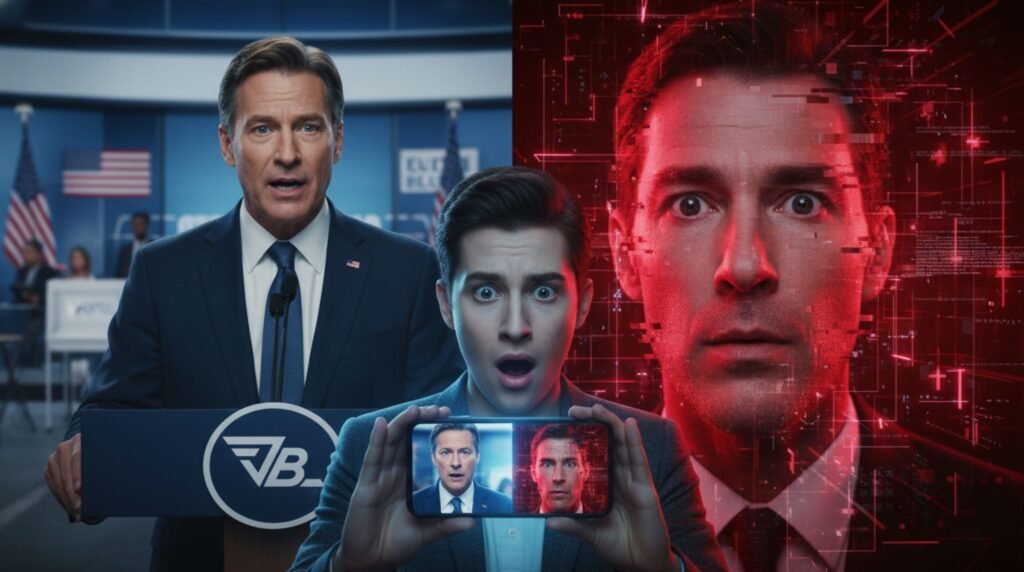
Imagine you are checking your phone and you see a video of your boss or the President saying that your company is shutting down. It is not true.. You get a call from someone who sounds just like a family member but it is really a fake voice asking you for money.
This is not something you would see in a movie. This is what is happening with deepfakes in 2026. They are not something that a few people are trying out. They are being used a lot. They are causing big problems for businesses and individuals. They are costing people a lot of money hundreds of thousands of dollars for each incident. They are also affecting elections. Making people doubt what they see and hear on the internet.
As of 2026 deepfake fraud is a problem. Deepfakes now make up 6.5 percent of all fraud attacks. This is an increase, 2,137 percent more than in 2022. One out of four Americans has already gotten a call, from someone using a deepfake voice. There are also a lot of deepfakes that are meant to hurt women and these have increased by 900 percent. Deepfakes are even being used to influence what people think about the elections. Deepfakes are changing the way people think about the -term elections.
In this no-hype guide, you’ll get:
- The latest 2026 stats and real-world incidents
- How deepfakes evolved into “Deepfake-as-a-Service”
- Regulations that are finally biting back
- Best detection tools and simple ways to spot fakes
- What businesses and individuals must do right now
Table of Contents
- Deepfakes 2026: Why They’re Suddenly Everywhere
- Jaw-Dropping Statistics & Real Incidents
- The New Threats: Scams, Porn, Politics & Corporate Sabotage
- Global Regulations Fighting Back in 2026
- How to Detect Deepfakes: Tools & Human Tricks That Still Work
- Practical Protection Guide for 2026
- What’s Coming Next (and How to Stay Ahead)
- FAQ
Deepfakes 2026: Why They’re Suddenly Everywhere
Remember when fake videos looked bad and only tricked people who were drunk? Those days are over.
Now with a new type of intelligence that can work with text, video and audio all at once plus services on the dark web that help create fake videos anyone with just $10 and some basic computer skills can make really realistic fake videos in just a few minutes. Some AI can even do everything on its making spreading and answering back to people.
The outcome is that these fake videos are not just videos. They are tools, for cheating, threatening, messing with elections and stealing company secrets.
Jaw-Dropping Statistics & Real Incidents (March 2026)
Here’s what the data actually shows right now:
| Metric | 2026 Figure | Change Since 2022/2024 | Source |
|---|---|---|---|
| % of all fraud attacks | 6.5% | +2,137% | Zerothreat / Keepnet Labs |
| Americans hit by deepfake voice calls | 1 in 4 | New 2026 baseline | State of the Call Report |
| Explicit deepfakes targeting women | 93% of all non-consensual content | +900% volume | Economic Times Report |
| Average cost per deepfake fraud | ~$500,000 | Industrial scale | ElectroIQ Stats |
| Teens targeted by deepfake content | 1 in 17 (ages 13–17) | Rising fast | Education Week / Statista |
This year we have seen some bad things happen. For example people made videos of company bosses and used them to take money from the company accounts. They also made fake voices of politicians to try to get people to vote for them.. Then there are these things called “laptop farms” that make millions of fake videos. Real incidents, like these have happened this year with fake CEO videos draining company accounts cloned politician voices swaying voters and these “laptop farms” pumping out millions of synthetic videos.
Deepfake evolution timeline — from 2014 experiments to 2026 industrial threat.
The New Threats: Scams, Porn, Politics & Corporate Sabotage
1. Financial Scams & Voice Cloning
Deepfake calls now beat mobile networks 2-to-1. Scammers use real-time voice cloning during “emergencies” — and it works terrifyingly well.
2. Non-Consensual Explicit Content
Women make up 93% of victims. Revenge porn and celebrity deepfakes have become a billion-dollar underground industry, with 1,780% growth in some regions.
3. Election Interference
Ahead of 2026 mid-terms, deepfakes of candidates are already circulating. Ireland’s 2025 presidential deepfake and U.S. synthetic ads show how one viral clip can shift votes before fact-checkers catch up.
4. Corporate & Journalistic Attacks
Impersonation attacks on executives and journalists hit 30%+ of high-impact cases in 2025. Reporters Without Borders tracked 100+ journalist-targeted deepfakes across 27 countries.
Global Regulations Fighting Back in 2026
The good news? Lawmakers are finally catching up.
EU AI Act
- Mandatory labeling of deepfakes and synthetic content (effective August 2026)
- New bans on non-consensual sexual deepfakes and tools designed to create them
- Platforms must act faster under the Digital Services Act
United States
- Preventing Deep Fake Scams Act (H.R.1734) targets voice and video fraud
- Federal “Take It Down Act” forces platforms to remove non-consensual sexual deepfakes
- State patchwork + C2PA watermarking standards gaining traction
Enforcement is ramping up — but the arms race continues.
How to Detect Deepfakes: Tools & Human Tricks That Still Work
No tool is 100% foolproof, but combining AI + human review beats the fakes most of the time.
Top 2026 Detection Tools (real-world tested):
| Tool | Best For | Key Strength | Free Tier? |
|---|---|---|---|
| CloudSEK | Enterprise & fraud teams | Threat-intel + real-time monitoring | No |
| Reality Defender | Multimodal (video/audio/text) | Patented multi-model accuracy | Limited |
| Sensity AI | Investigations | Forensic-grade behavioral cues | No |
| Sherlock AI | Interviews & hiring | Live deepfake + impersonation | No |
| Hive AI / UncovAI | Everyday users | Browser/Zoom real-time checks | Yes |
Quick Human Checks You Can Do Right Now:
- Watch for unnatural eye blinks, lighting mismatches, or audio lag
- Ask for live verification (video call with specific actions)
- Check C2PA metadata or provenance labels
- Reverse-image search + fact-check the source
Detection playbook: signals, team actions, and quick trials that actually work in 2026.
Practical Protection Guide for 2026
For Individuals:
- Never act on urgent requests without independent verification
- Use apps like Trend Micro ScamCheck or browser extensions
- Enable 2FA everywhere and avoid sharing high-res face/voice data
For Businesses:
- Mandate live video verification for high-value transactions
- Deploy enterprise tools like Reality Defender or CloudSEK
- Train teams on deepfake awareness quarterly
- Adopt C2PA watermarking on all official content
For Everyone: Demand platforms label AI content. Support bills that hold creators and enablers accountable.
What’s Coming Next (and How to Stay Ahead)
By 2026 we can expect to see deepfake campaigns that can change and adapt in real time. These will be very hard to spot. The people who will succeed in dealing with them are those who use technology create rules and are also very skeptical. The fight, against deepfakes is not yet. But its not just one side that has all the power.
What is the frightening deepfake you have seen recently? Share it in the comments. I will help you figure out what it is and suggest the way to detect it.
Do you want to keep yourself safe?
You should try the scanner from Reality Defender at realitydefender.com
You can save this post because we will add new information to it when we find out about new threats and tools that Reality Defender has.
FAQ
Q: Are deepfakes illegal in 2026?
Not all of them — but non-consensual, fraudulent, and election-related ones face serious bans and penalties in the EU and growing U.S. states.
Q: Can AI really detect every deepfake?
No single tool is perfect, but layered detection (AI + human + provenance) catches 90%+ of sophisticated fakes today.
Q: How do I protect my voice and face?
Limit public high-quality media, use voice changers for sensitive calls, and verify requests in person or via secure channels.
Share this with friends, family, and your team — because in 2026, seeing isn’t believing anymore. Stay sharp out there.